


The trade pattern that India was expected to follow in 2025 was paradoxical in itself. The trade landscape in 2025 highlighted the vulnerability of the global market due to various changes in trade policy tariffs, trade agreements, and other factors. Although it was challenging to ascertain certainty at that moment, the trade flow remained largely intact.
The statistics of India in 2025 indicated a two-speed economy, which is import-dependent in core areas but export-competitive in several value-added sectors. In this blog, we will explore how the Union Budget of India in 2026 can influence the country’s global trade. Additionally, we will discuss the new policy and tariff changes in the global economy that can impact the trade pattern of India in 2026.
At first, let’s discuss about…
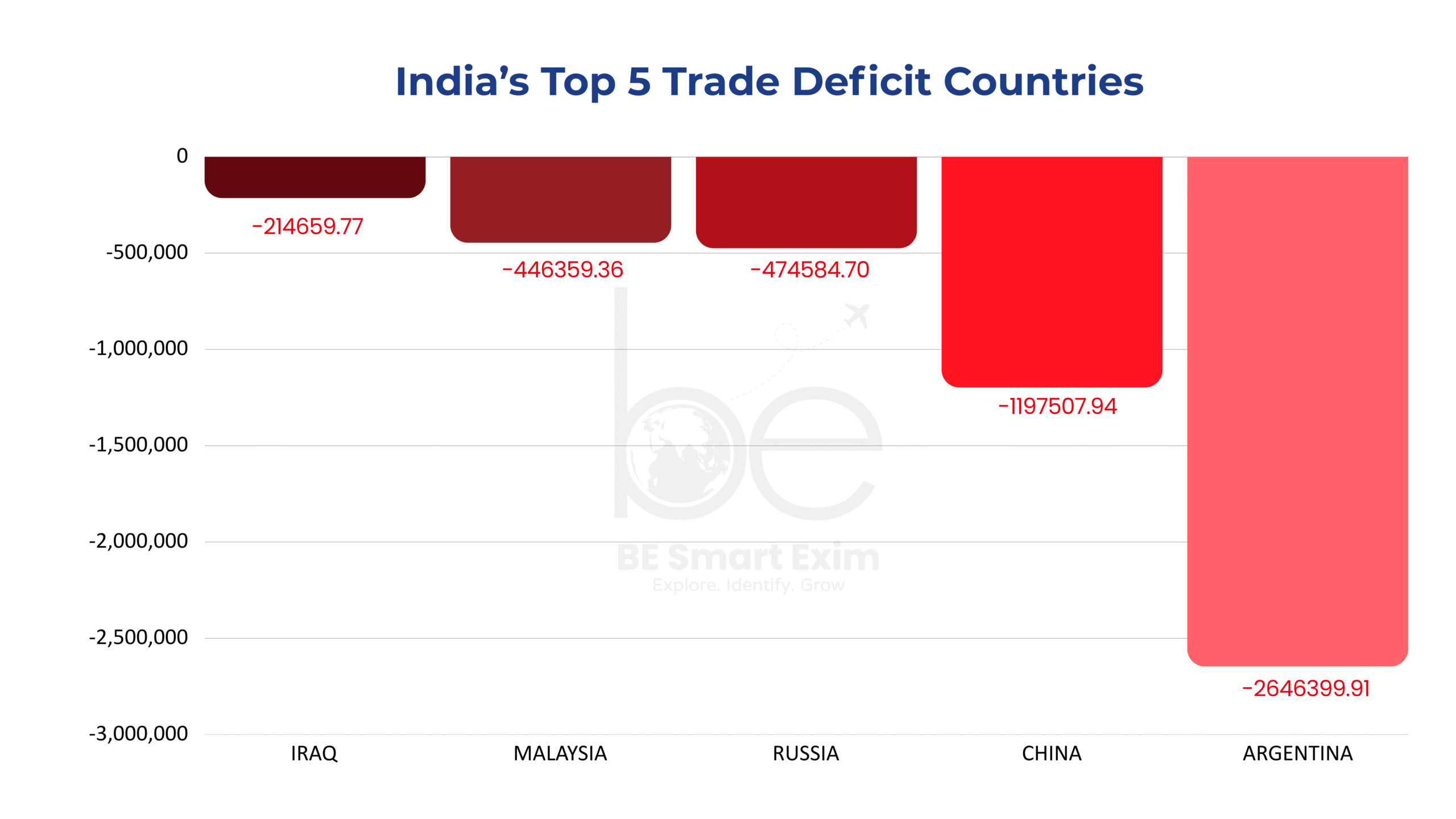
The Deficit Axis: Concentrated Exposure
Here we have selected the top 5 countries with which India shared the largest trade deficits in 2025. The largest trade deficit in 2025 continued to be with China, which accounted for nearly ₹11.98 lakh crores. Electronics, electrical, telecom machinery and equipment and industrial components are the main imported items from China. These imports are the backbone of the Indian manufacturing and infrastructure sector, but they also indicate a deep dependence on these sectors.
The trade deficit with Russia, which stands at around ₹4.75 lakh crores, was mainly energy-related. The import of crude oil dominated trade between the two countries.
In Argentina, the import exposure increased significantly due to commodity imports, particularly in agriculture-related sectors. According to market data, India imported a large quantity of soybean oil from Argentina.
Similarly, the trade deficits with Saudi Arabia and Iraq are indicative of a structural dependence on hydrocarbon imports.
The Surplus Axis: Competitive Strength
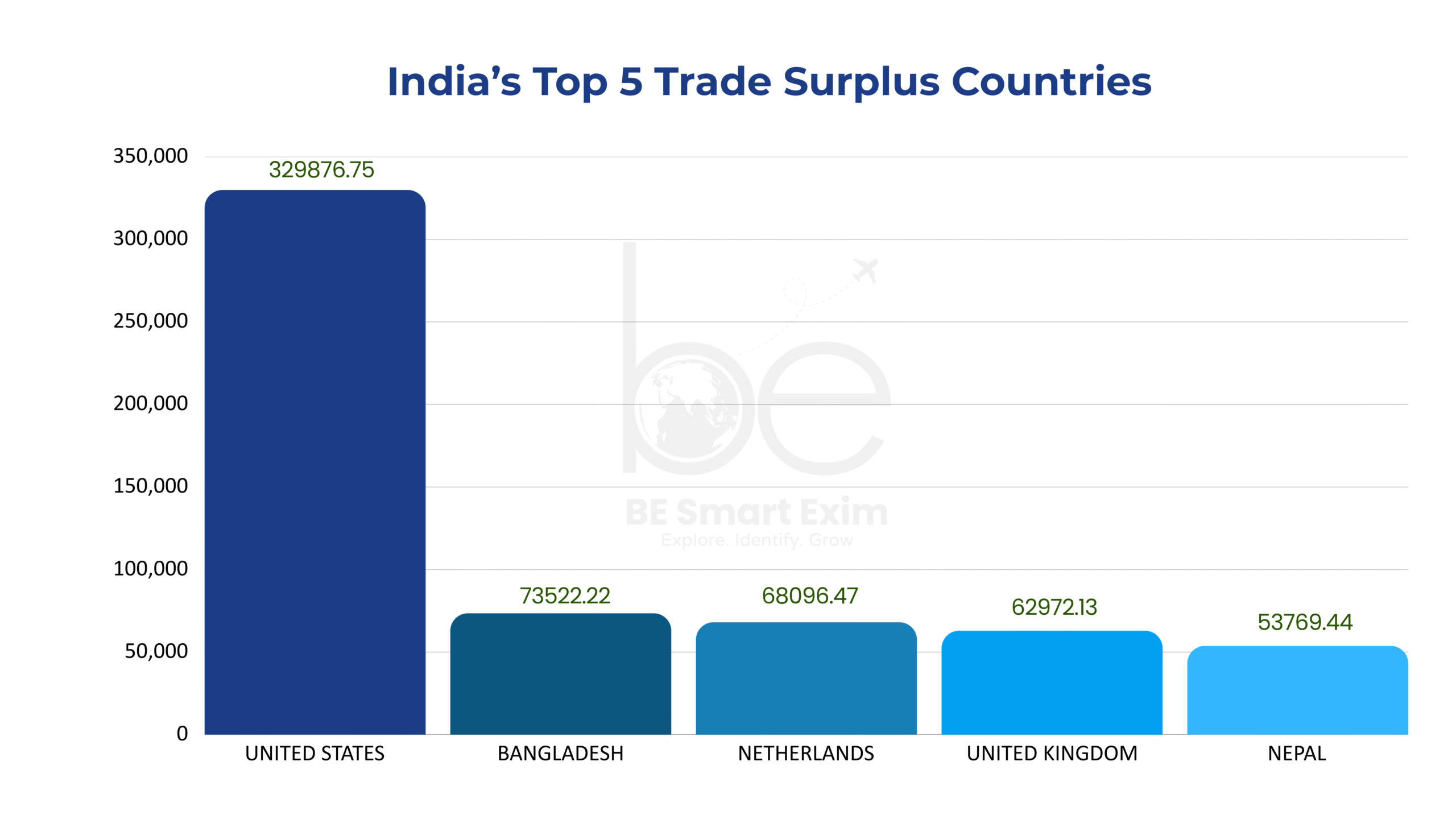
Conversely, India has registered significant trade surpluses with various markets in 2025. The United States has continued to be one of the largest countries with which India has a trade surplus, thanks to the export of pharmaceuticals, engineering goods, textiles, and IT-enabled services. Trade with Bangladesh has also registered a steady flow of trade surpluses, thanks to the export of yarn, fabric, and industrial supplies.
European markets like the Netherlands have also registered positive trade, thanks to India’s growing importance in the export of chemicals, petroleum products, and engineering goods. Such trade surplus relationships point towards the sectors where India has developed value addition, pricing power, and export competitiveness.
The country-wise breakup of trade surpluses presents a different picture of India’s trade regime, which is based on scale, manufacturing prowess, and services dominance.
Strategic Direction in Union Budget 2026: Balancing Growth Speeds
The 2026 Union Budget aims not only to cut deficits but to achieve a balanced economic strategy. It focuses on enhancing manufacturing to lessen reliance on countries with high deficits. In the Budget 2026, the Government is aiming to set up Chemical manufacturing hubs to help India manufacture chemicals domestically and reduce export dependency to some extent. It also proposes duty-free capital goods for key high-tech sectors to lower the setup cost for manufacturing plants, while encouraging electronics production in India by supporting the supply of tools or machinery. Additionally, the Government plans to encourage domestic companies to produce certain goods by removing import exemptions and export procedures, and GST refunds will be simplified to support manufacturing exporters. Let’s elaborate on it more
- Indian fishermen who are fishing in the international borders are allowed to sell fish abroad as well, and it will be counted as an export. As a result, the value of seafood exports will increase, affecting the BOT of some specific countries.
- Small sellers can export any values through courier companies. By this, many small businesses or MSMEs can collaborate with the courier companies and start exporting their products. And increase the Indian export values.
- Duty reduced on Critical Minerals – monetary duty became Renewable energies (Solar glass raw materials and battery energy storage machinery) import duty became Nil. Nuclear projects import duty, Nil, till 2035. Zero import duty on Microwave oven parts, Aircraft parts and engines, rare disease drugs, Shoes uppers. Due to this, the import gets cheaper, and import volume will increase, and India’s trade deficit will increase with some major countries like China, Russia, etc.
- On the other hand, duties increase in some sectors, like Chemical Import (Potassium Hydroxide) duty increased to 5%. Umbrella & parts have a minimum duty amount. As a result, the import of these products will decrease.
- Export benefits for seafood sectors where duty-free input limits were raised 1% to 3%. Longer export time available for Textile, Leather & Footwear industries, now get 12 months instead of 6 months. This rule helps to expand India’s export volumes in the mentioned sectors.
In this blog, we aim to illustrate how the Union Budget 2026 may impact India’s import and export activities, ultimately influence the trade balance and promote a more export-oriented economy.
In addition, it is important to consider how changes in tariffs in global markets will impact India’s market this year. Stay tuned for more insights and information on the global market and import-export trade activities with us.