


The shifts in global markets in 2025 and the new opportunities in the Global Market of 2026
The export industry in India has proved to be extremely resilient in 2025, and despite being hit hard by the hard reality of international trade protectionism and geopolitical upheavals, and even with very high tariffs being imposed by important export markets, the outlook has remained stable and even continued to move forward, making 2026 look promising.

Exports Stayed Strong Despite Tariff Shocks
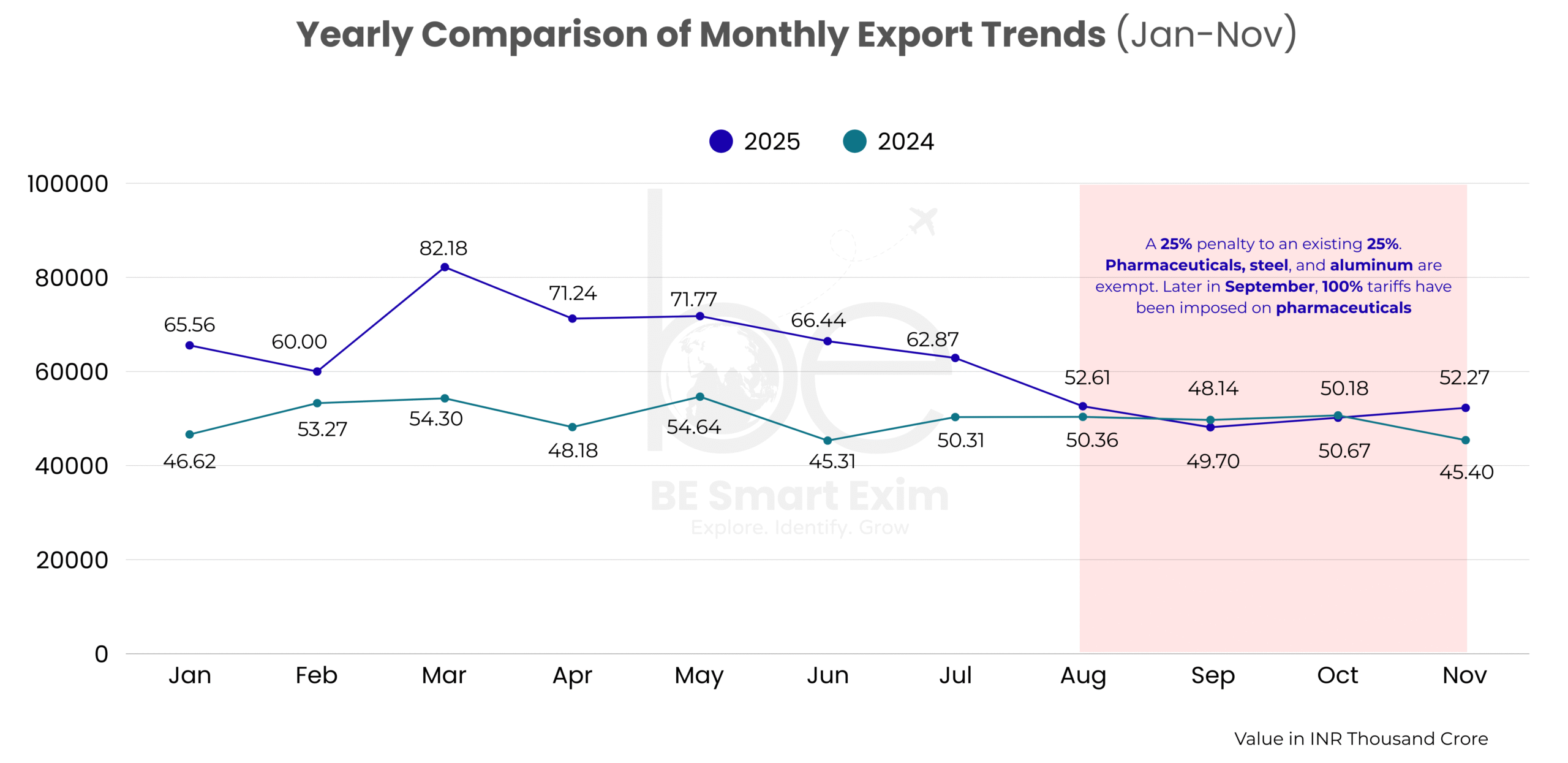
The year 2025 was characterized by the implementation of a 50% tariff imposed by the United States on a wide range of goods from India. Although this disrupted the usual trade patterns and contributed to slowing exports to the main trading partner of India, Indian exports were able to adjust to this challenge by means of diverse strategies.
There were fluctuations in the exportation of products to the US regarding tariff pressure in September and October 2025, but in November, the exportation increased dramatically to USD 6.98 billion, having improved by 22.61% from the previous months.
Diversification Mitigates Tariff Impact
In 2025 (Jan to Nov), from India to the US, total exports were 683.27 thousand Cr INR. Industries like electrical & electronic equipment and their parts (HSN 85), with the value of 209.71 thousand Cr. INR; mechanical machinery (HSN 84), with the value of 64.79 thousand Cr. INR; pharmaceutical products (HSN 30), with the value of 53.89 thousand Cr. INR; gems & jewelry (HSN 71), with the value of 34.73 thousand Cr. INR; and articles of iron & steel (HSN 73), with the value of 27.13 thousand Cr. INR, are the top 5 exported items in this period.
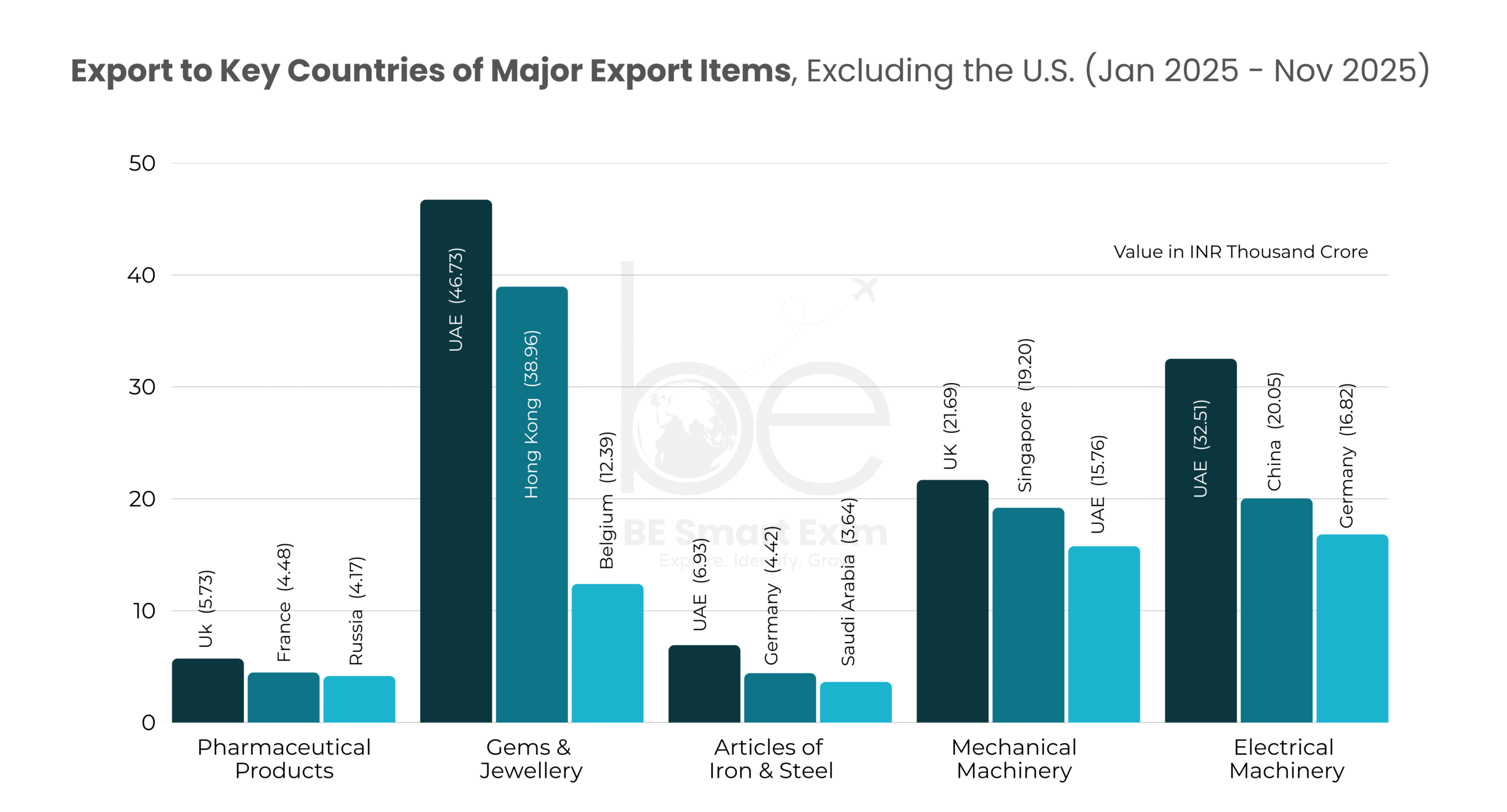
While the US is a significant importer of Indian products, several other countries also import large quantities of goods from India. Following the implementation of tariffs by the US, India began to focus on diversifying its export destinations.
The chart below shows the major industries that have expanded their export reach beyond the US market.
India’s Free Trade Agreements in 2025
One factor that has made India’s 2025 exports so resilient is the active trade diplomacy that the country has followed. Various new free trade agreements that have high impact potential were signed by India in 2025, in addition to making previous agreements operational, which has enhanced market access to a large extent.
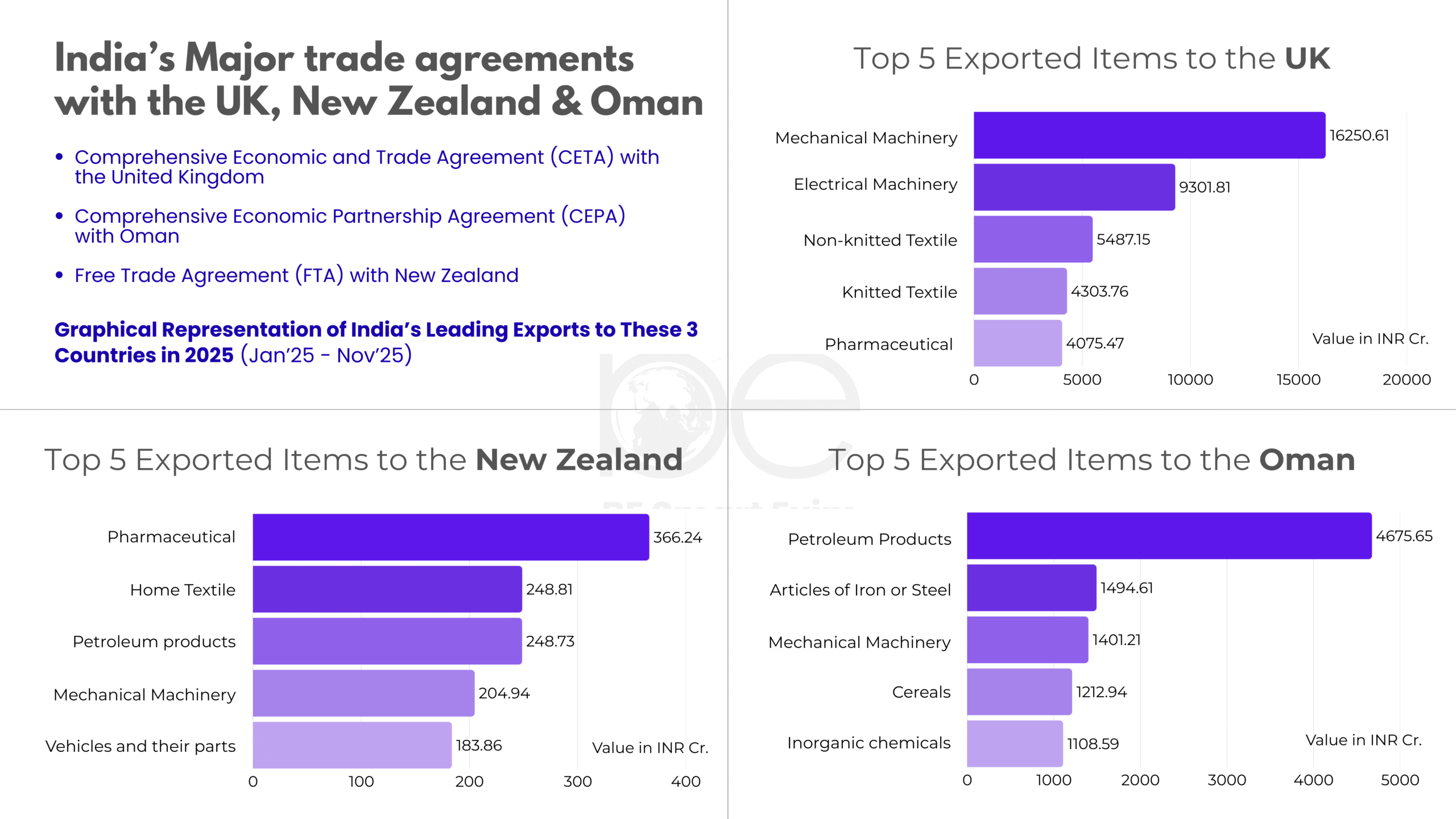
The UK: India began the second half of 2025 by signing the Comprehensive Economic and Trade Agreement (CETA) with the United Kingdom, which is the most extensive trade agreement that India has undertaken till now and the first major trade agreement with a G7 nation in the last decade. The agreement gives Indian products like textiles, leather, and footwear near total duty-free access; besides that, the agreement has also relaxed mobility arrangements related to service sector professionals. The announcement of the India-UK Vision 2035 has enhanced collaboration in the fields of defense, climate change, and technology.
Oman: India has also enhanced its presence in the Gulf region with the signing of a Comprehensive Economic Partnership Agreement (CEPA) with Oman in December 2025. The CEPA provides for zero duties in most lines with a value equivalent to almost all Indian exports to Oman. This increases India’s strategic influence in Africa and Central Asia.
New Zealand: The India and New Zealand Free Trade Agreement, signed in late 2025, provides zero-duty access for 100% of Indian products. The agreement is expected to increase the competitiveness of India’s MSMEs and boost the diversification of the Indian market. The agreement would reduce the impact of tariffs on India’s exports.
At the same time, the Trade and Economic Partnership Agreement (TEPA) between the European Union (EU) and the European Free Trade Association (EFTA) came into force in October 2025. It is characterized by the commitment of investment in the tune of USD 100 billion over 15 years, which is likely to create plenty of jobs.
Moreover, the investment regime in India was bolstered by Bilateral Investment Treaties in Uzbekistan and Kyrgyzstan and a new treaty in Israel.
These are in addition to other agreements that promote India’s focus on diversification in export markets and building competitiveness in 2026 and beyond.

Conclusion
India’s export performance in 2025 makes it evident that it has not only been resilient in international competition but has also been able to perform well under high tariffs as well. As India is ready to benefit from free trade agreements in a bigger way and is all set to increase its global presence very soon, it can be logically speculated that the coming year, 2026, too, may follow suit.